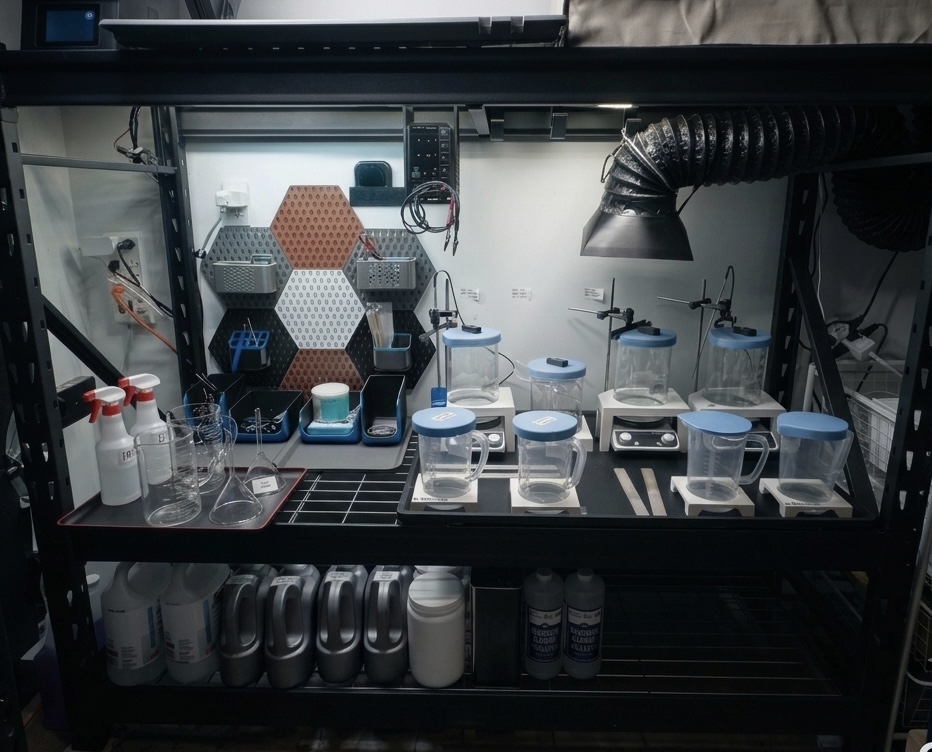
Most plating you’ll see online happens on a kitchen counter with a marmalade jar and a hope: the whole watch dropped in fully assembled, movement and all. This doesn’t. K-Plating runs from a dedicated lab with temperature-controlled baths, filtered rinses, a D65 booth for reading colour, CIELAB-proven colour matching, processes validated by X-ray fluorescence (XRF), and a bench for testing hardness and wear, because the things that decide quality should be measured, not assumed.
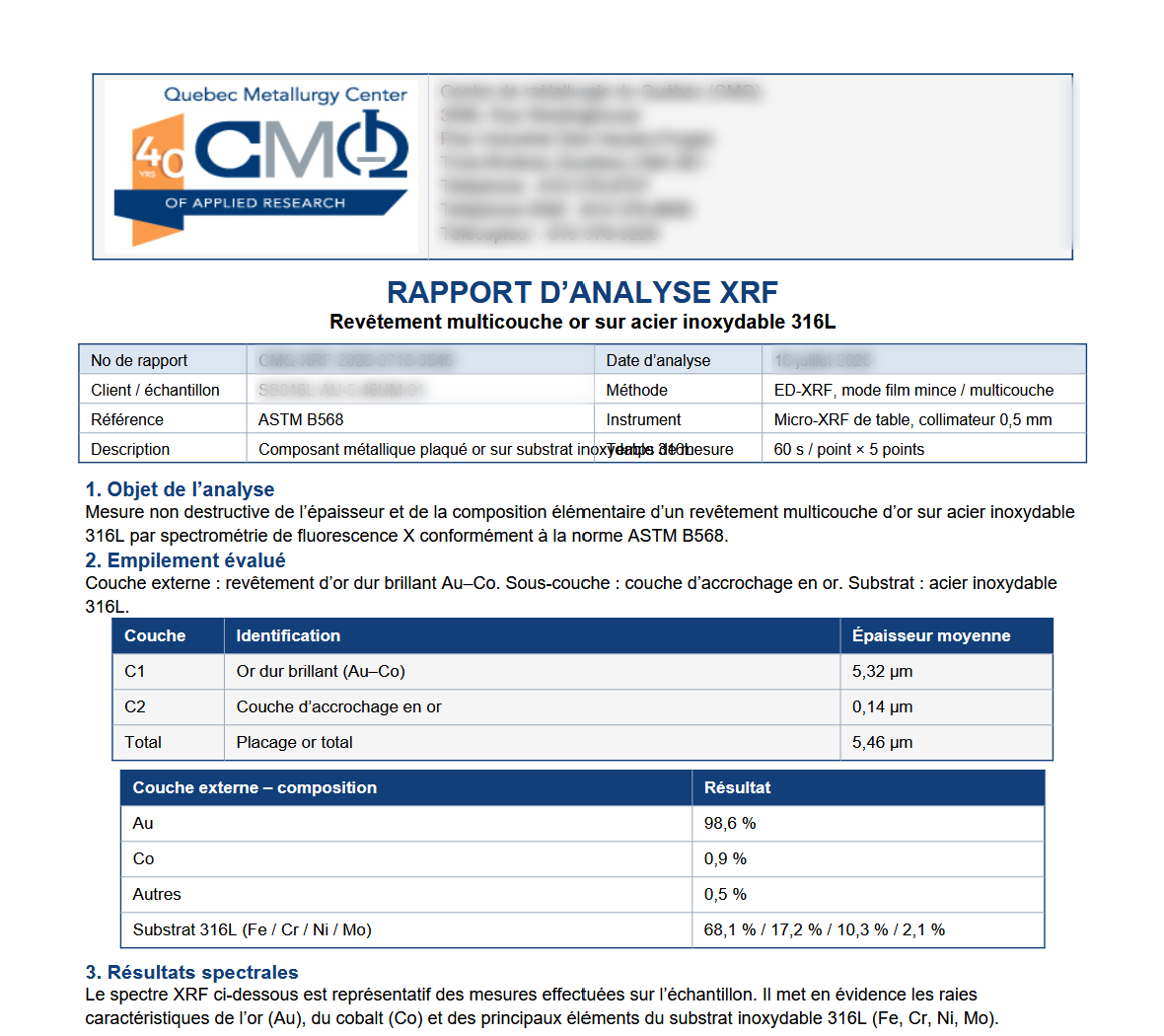
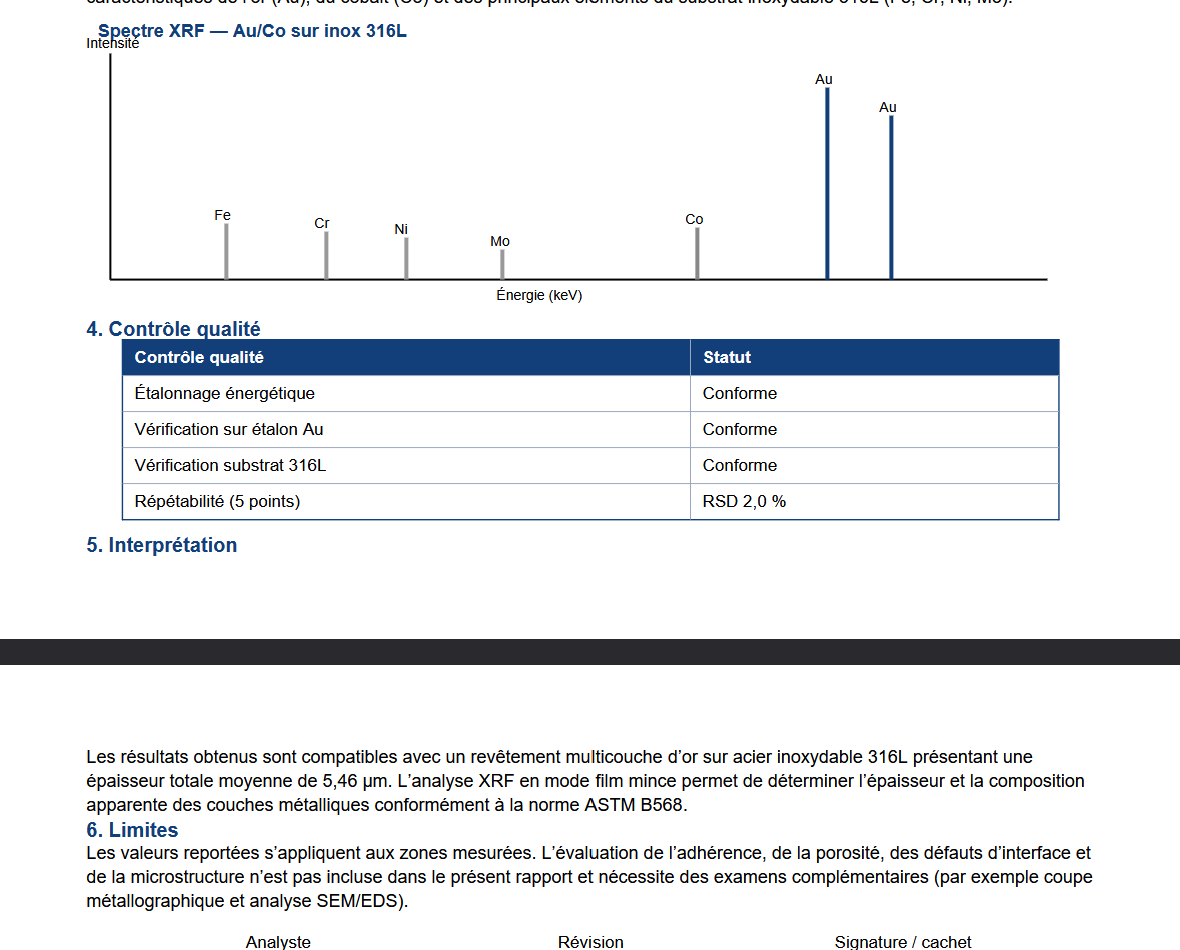
The build is assayed by independent XRF at an accredited lab, not our own instrument grading our own work. The report shown here reads 5.46 µm total gold at 98.6% Au. We run this validation quarterly to confirm the process holds.
Nothing here is for show. Each stage exists because skipping it is exactly how a plate fails, in a week, or in a year.
The watch comes apart: movement, dial and hands out, bezel, case-back and crown off, the bracelet taken apart, each part handled and racked on its own. This is the step most of the trade skips, dropping the whole watch in fully assembled instead. A closed watch traps solution, leaves blind spots the current never reaches, and carries oils and old grease straight into the bath, contaminating the chemistry for everything that follows. Loose parts mean the deposit reaches every accessible surface, inside and out, evenly. It is the single biggest reason this work costs more than a dip-it-as-it-sits job, and the single biggest reason it lasts.
A multi-stage clean: two manual cleaning procedures, a purpose-made watch cleaning fluid degrease, ultrasonic isopropyl, an electro-clean, and an electrolytic activation that strips the last invisible oxide layer so the deposit bonds to bare, active metal. This is where most of the time goes, and where most plating jobs quietly fail before they even start.
Not one dip, but a layered structure across multiple gold types, built up to 6 µm where a piece calls for it. The wearing surfaces go down in cobalt-hardened hard-gold, which resists scuffs and edge wear far better than the soft 24K flash most shops finish with.
Bath chemistry, current and timing are validated quarterly by independent XRF at an accredited lab, so we know what thickness a given run produces. The XRF validates the process, not each individual watch: your piece is plated to parameters already proven rather than to a number being hoped for. Colour is held to the same standard, quantified by spectrophotometry in CIELAB coordinates so a tone is a measured value with a stated ΔE, not an opinion.
For Rolex, the finish is measured against modern genuine Rolex through our comprehensive colour-reading process in a standardized D65 daylight booth, and checked for tone consistency across the whole assembly, case to clasp. Gold tone shifts under bad light; this removes the guesswork.
A final inspection under magnification, careful reassembly, and a final QC pass. Every watch, tone-matched or not, clears the same finish-quality gate before it ships back, tracked and insured.
“5 microns” gets quoted like a guarantee. It isn’t. A thick deposit over a dirty, un-activated surface peels just as fast as a thin one, sometimes faster. Thickness only matters once everything underneath it is right. Here’s what actually decides whether a plate survives real wear.
A deposit is only as good as its bond to the metal beneath. Proper degreasing and electrolytic activation are what keep gold from lifting at the edges. Skip them and no amount of thickness saves you.
Soft 24K looks great for a week, then scuffs on a desk edge. The wearing surfaces go down in cobalt-hardened hard-gold at roughly 200 Knoop, over a palladium underlayer near 400 Knoop. And it is not a number you have to take on faith: watch a driver dragged across the finish, acrylic glue pulled off it, and 3M tape lifted from it, three tests on camera.
In electroplating, the metal builds up wherever the electrical current is strongest, and that current naturally concentrates on outer edges and corners while thinning out inside tight recesses. Left alone, that means bald, under-plated spots deep in the lug slots and between links. To counter it, we plate the watch fully disassembled and rack each component individually, positioning and spacing every part so the current reaches into the recesses instead of racing around the outside. The result: the hidden interiors get the same gold thickness as the flat, easy-to-reach faces.
On Rolex, tone is measured under controlled D65 illumination against modern genuine Rolex, so the gold reads right in daylight, not just under a warm bulb that flatters everything. The target tone is set in CIELAB against the real thing, so the match is measured, not eyeballed.
Thickness is controlled by charge: current density and time per surface area. The process is validated quarterly by independent XRF at an accredited lab. Hardness is not a number quoted at you. The cobalt-hardened gold runs about 200 Knoop over a palladium underlayer near 400 Knoop, and you can watch it proven on the bench: a driver dragged across the surface, acrylic glue pulled off it, and 3M tape lifted from it, all on camera. What you get is a finish built to a standard you can be shown, not just told.
Tell us what you’ve got. A $25 deposit holds your place on the bench.